
A New Brain: Composing through Crisis

Part One: Why this musical matters to me
It is rare you find a piece of art that feels so personal, or in my case anyway, something you watch and genuinely feel connected to. I was playing on my playstation in December when I decided to listen to a musical that starred Jonathan Groff, you might recognise the name as he is in Mindhunter, voices Kristoff in Frozen, as well as being King George III in Hamilton.
So I’m there playing FIFA of all games, the most rage-inducing game one can possibly play when I start paying more attention to the soundtrack. I knew the musical was one about a stroke but I didn’t expect it to have such an effect that it would lead me to want to write about it, especially when the stroke in question is an AVM.
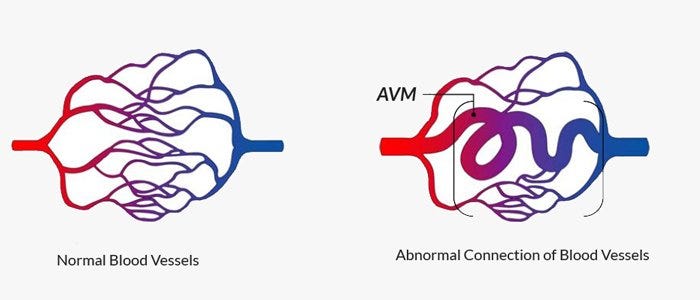
An arteriovenous malformation, or AVM, is a rare vascular anomaly, an abnormal tangle of blood vessels that bypasses the capillary system, creating a dangerous shortcut between arteries and veins. It’s usually congenital, meaning you're born with it, for some people including myself it remains silent until it ruptures, in my case, it ruptured in March 2012 while watching Joseph and the Amazing Technicolour Dreamcoat of all things, this rupture leads to a hemorrhagic stroke. That’s what happened to me.
Part Two: The personality of A New Brain
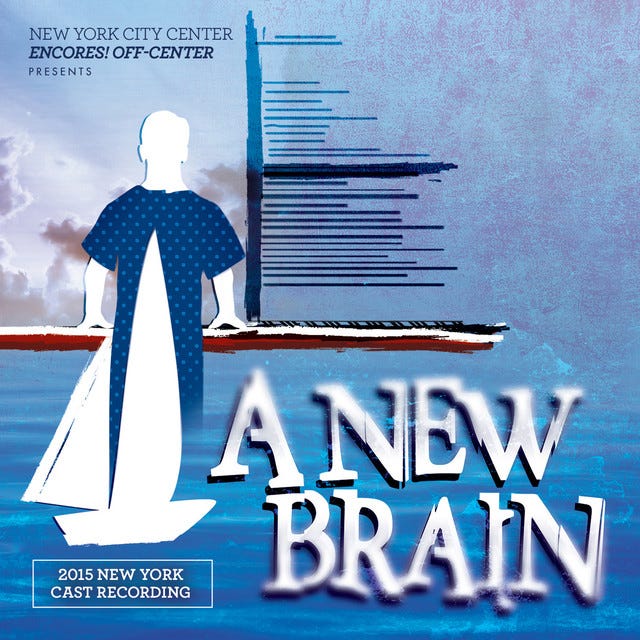
What happens to Gordon, the protagonist of A New Brain, a musical that somehow manages to capture the chaos, fear, and strange beauty of surviving something like this. Listening to it felt like being shown a mirror of my life, with small differences here and there. Again, it is a piece by William Finn, much like Falsettos the music and lyricism is very similar, the story also revolves itself around a gay man with Jewish heritage. The themes throughout A New Brain deeply reflect the reality of experiencing an arteriovenous malformation (AVM), especially the looming presence of mortality and the fear of death. This isn’t just something Gordon, the protagonist, experiences; it radiates outward to his family and friends. I was only eight years old when it happened to me so my understanding of death was not as complete as my family, but the long-term effects along with what I’ve been told about my time in the hospital have helped me understand just how much life can be turned completely upside down.
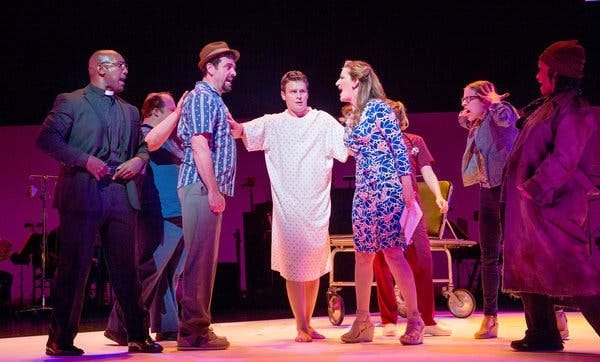
One moment Gordon is writing music; the next, he’s in a hospital gown, his future uncertain, exactly how I felt when I was in the theatre car park then all of a sudden I was being taken to hospital. That sudden shift is all too familiar. What’s striking about Gordon as a character isn’t just that he’s afraid of dying it’s that he’s afraid of dying unfinished, as he has “so many songs”. He worries about leaving behind unwritten songs, an incomplete story. That’s something I deeply relate to, even if I couldn’t have fully articulated it at the time. I knew I was very unwell, even if I didn’t understand just how unwell I was.
And yet, there were moments of light during that time that stuck. One of them was meeting Tim Cahill and Phil Jagielka, two footballers who played for Everton at the time, also watching football on the telly, and the first time laughing after my operation was from a some old corny joke book. These serve as reminders that even when everything feels uncertain, human connection and surprise can still break through fear. It was also pretty cool to say to my friends that I’d met some football players, I still tell people that today.
The song that defines A New Brain for me is ‘Heart and Music’. It’s more than a catchy phrase, it feels like a survival instinct. When I had my stroke, I didn’t have the words to explain what was happening to me, let alone the tools to express it. But this song captures something I’ve felt ever since: to keep going, you need both emotion and expression. You need heart and music (as corny as that is). Whether that’s writing songs or just holding on to the small rituals that remind you of who you are, creativity becomes a lifeline, something that grounds you when everything else is spiralling.
For Gordon, music is what keeps his mind from collapsing in on itself. This song is the show’s heartbeat and acts as a motif, the thing that keeps it emotionally alive and it is repeated at the end when Gordon has recovered, only it is called ‘Time and Music’ which recognises his survival and the fact we do have time, more than we realise.
At the point when ‘Heart and Music’ occurs, Gordon has just learned about his medical emergency, but hasn’t yet had surgery. He’s terrified and overwhelmed, already slipping into the world of his imagination as a means of coping. This number isn’t just a song, it’s a creative outburst, a psychological defence. Voices from his past and present flood in: his lover, his mother, his friends, a nurse, even the children’s TV host he writes for. It’s chaotic and surreal but somehow also deeply centering. In that mess of memory and fear, Gordon finds clarity: he survives by creating. William Finn’s A New Brain is remarkable for its ability to capture moments of light during some of the darkest periods in life.
One of the most powerful examples of this is the song ‘Sailing’ which plays like a dream sequence, a quiet escape from the chaos. In it, Gordon’s boyfriend, Roger, becomes an emotional anchor within the storm of Gordon’s mind. Much like in Falsettos, Finn doesn’t rely on grand gestures to deliver emotional weight. Roger doesn’t try to fix Gordon, no one can, but what he offers is steadiness, calm, and presence. In a world of hospital gowns and uncertainty, that kind of love is its own kind of medicine.
This serenity is sharply contrasted with Gordon’s mother, Mimi Schwinn, who is the embodiment of maternal fear and control. ‘Mother’s Gonna Make Things Fine’ is both heartbreaking and relatable, a mother’s desperate mantra in a situation she can’t control. Even when Gordon lashes out at her, Mimi loves him unconditionally. She shows up, stays present, and fights in her own way. Their relationship is complex, layered with guilt, frustration, and deep love and Mimi’s journey mirrors Gordon’s: from panic and denial to surrender and acceptance.
Mimi doesn’t just represent Gordon’s personal history; she stands in for a whole generation of parents watching their children suffer through things they don’t fully understand. Her arc reminds us how helpless love can feel, and how powerful it still is. I wish I’d been able to appreciate my own parents' strength when this was happening to me. But shows like A New Brain allow for reflection on my own level, and this is where I highlight the point of writing about this musical. Finding art that we can reflect and engage with emotionally is great, but personally, well that’s even better.
This is where I thank my parents for literally staying by my side the entire time I was in Hospital, and for continuing to check if I take my medicine, they have been the most important parts of my life and have always supported me and my weird micro obsessions (this is one of them).
Part Three: Making it to Spring
Listening to A New Brain now, years after my stroke, I see a version of my own story, not in the details, but in the emotional undercurrent: the chaos, the fear, the strange beauty of surviving. Gordon isn’t a hero in the traditional sense. He’s scared, messy, self-involved and completely human. He doesn’t emerge from his illness fixed or enlightened. But he does come back with a clearer understanding of what matters: the people who show up, the art that helps us cope, and the weird, hard miracle of being alive.
For me, writing this is part of that same process. My own ‘heart and music’ I didn’t write songs in the hospital. I wasn’t even old enough to know what was happening, but now, with hindsight and distance, I can try to shape the experience into something meaningful and possibly even help others if the time ever comes that I need to be the support beacon. And that, I think, is what William Finn’s musical offers: not closure, but clarity. Giving me a new perspective of the stroke, I have been diagnosed with epilepsy due to the AVM since 2013 now, starting with absences and eventually leading to tonic clonic and focal seizures that I still have to this day.
But sometimes, survival from these sorts of things doesn’t mean perfection, sometimes life is just about living.
I really enjoyed writing about another William Finn musical, especially this one but I will move to a different writer for the next post. I’ll aim for 21st, but consistency is clearly not my best ability.
Thanks if you read,
Jack (: